Cardamom-Spiced Rhubarb Kuchen
A German-Russian custard kuchen for the first rhubarb of spring.
Published May 20, 2026
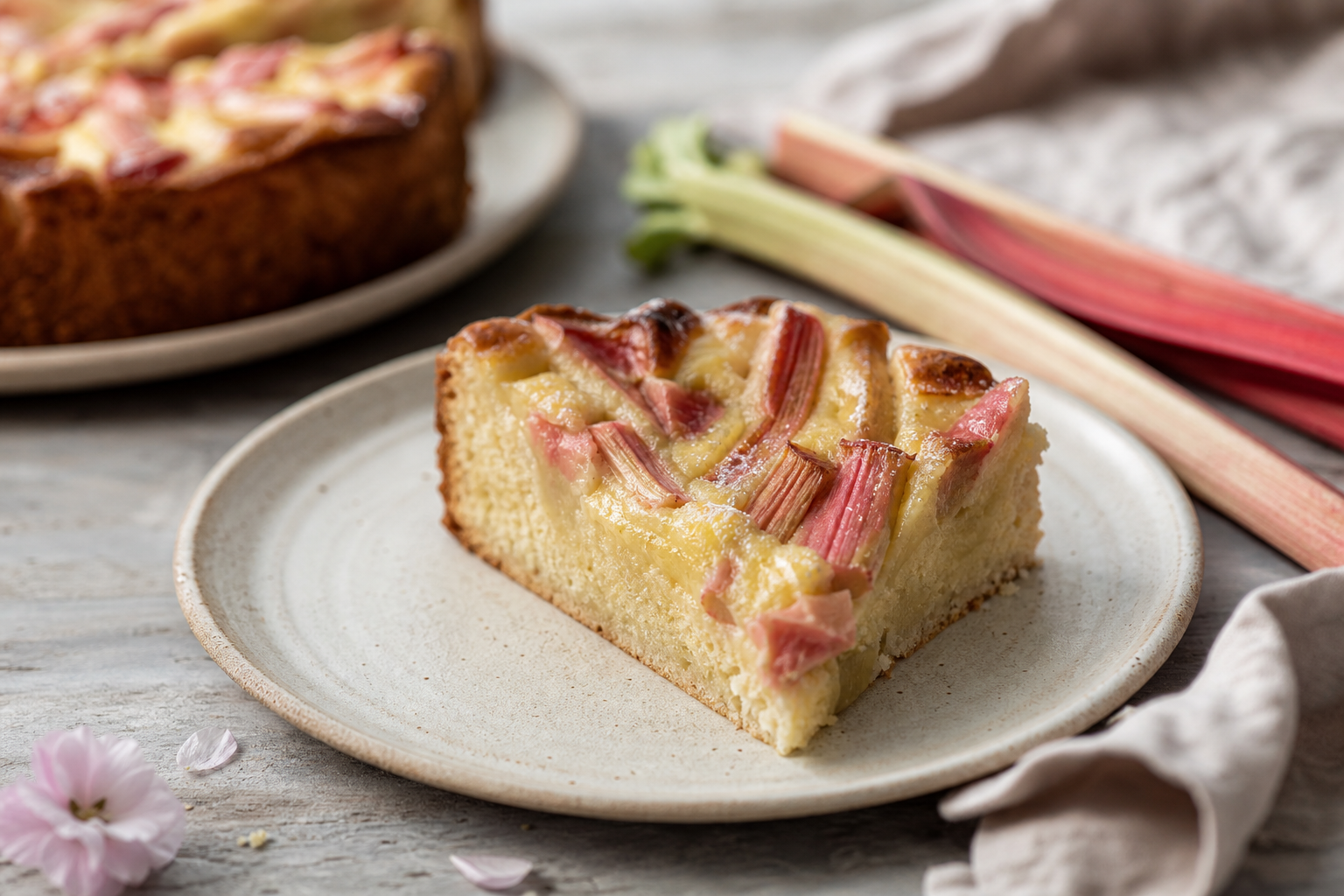
Kuchen is one of those words that means different things in different contexts. In standard German it just means cake, broadly. In the dialect of the German-Russian immigrants who settled the northern Plains in the late nineteenth century, it means something more specific: a yeasted dough base with a fruit and custard topping, baked in a round or rectangular pan, served at room temperature with coffee. This is the kuchen that became a household tradition in the German-Russian farming communities of North Dakota, South Dakota, and central Minnesota, and it is the kuchen that survives today in church cookbooks, farm kitchens, and small-town bakeries from Bismarck to Bemidji to New Ulm.
The German-Russian community in Minnesota is one of the state's less-visible immigrant groups. The major waves arrived between the 1870s and the 1910s, mostly from the Volga region of Russia where the Volga Germans had been settled since Catherine the Great invited German farmers to populate the steppe in the 1760s. By the late nineteenth century, Russian policies had become hostile to the German communities, and many emigrated en masse to the American Plains. They brought a hybrid food culture with them — German in its grammatical structure, with Russian and steppe influences in specific dishes — and they settled heavily in central and western Minnesota, building communities in places like Wabasso, Bird Island, Olivia, and the corridor along the Minnesota River.
The Yeasted Base
The choice of a yeasted dough rather than a pastry crust is one of the things that distinguishes kuchen from pie. A pastry crust would produce a different object — flakier, more delicate, more about the contrast between the crust and the filling. The yeasted dough produces something more bread-like, more substantial, more integrated with the topping. It rises slightly during the bake. It absorbs some of the custard. The finished kuchen is a single thing rather than two layers stacked together, and the texture is closer to a sweet bread than to a pie.
The dough is enriched with butter, sugar, and an egg, which makes it softer and more tender than a standard bread dough. Let it rise once, knock it down, press it into a buttered pan to about a half-inch thickness, and let it rise again briefly before topping and baking. The dough should be supple and slightly sticky when you press it into the pan; if it is dry and stiff, the kuchen will come out heavier than it should be.
Cardamom in Two Traditions
Cardamom has the unusual distinction of being a heritage spice for two of Minnesota's major immigrant communities. The Scandinavians use it heavily in their baking — in the Norwegian julekake and the Finnish nisu and the Swedish vetebrod — and the German-Russians use it as well, in their kuchens and their coffee cakes and the specific Russian-German treats that traveled across the steppe with the community. The two traditions arrived at the same spice through different routes, and in Minnesota they reinforce each other. Cardamom in a Minnesota baked good is not exotic. It is doing the same work that vanilla does in most American baking — providing a warm, slightly floral background that supports the other flavors without dominating.
For the kuchen, the cardamom goes into the custard. Use whole green cardamom pods, crushed open and added to the cream while it warms, then strained out before the eggs go in. This produces a cleaner, more aromatic result than ground cardamom, which can taste soapy if too much is used or if it has been sitting in the spice rack for a year. A quarter teaspoon of freshly ground cardamom is the alternative if you cannot find pods.
Rhubarb's Refusal
Rhubarb is the right fruit for a kuchen because it does not collapse into sweetness during the bake. The acidity holds. The custard around it gentles the tartness without erasing it. The bite of finished rhubarb kuchen is the bite of fruit that has retained its own character against the surrounding sweetness, and that contrast is the whole point. Chop the rhubarb into half-inch pieces, scatter them across the pressed-out dough in a single layer, and pour the cardamom custard over the top. The rhubarb should be visible through the custard, not fully submerged. As the kuchen bakes, the rhubarb releases some of its juice into the custard, which produces small streaks of pink throughout the finished topping.
If the rhubarb is particularly tart — which it often is in the first weeks of the season — you can sprinkle a tablespoon or two of sugar over it before pouring the custard. This is optional. The custard itself carries enough sugar to balance most rhubarb without additional help.
The Bake and the Jiggle Test
Bake until set is the kind of instruction that requires interpretation. The custard needs to hold together when you cut into it, but it should not be rubbery or curdled. The right indicator is the jiggle test: shake the pan gently, and watch the center of the custard. If it moves as a single unit — like firm Jell-O — it is done. If the center is still liquid and ripples independently of the edges, it needs more time. If the whole thing is rigid and dry-looking, it has gone too far. The window is fifty to sixty minutes at 350 degrees for a typical nine-by-thirteen pan; check at forty-five and adjust from there.
Cool the kuchen in the pan to room temperature before serving. Warm kuchen is fine, even nice, but the custard is at its best when it has set fully and the flavors have had thirty minutes to integrate. Serve with strong coffee. The kuchen will keep at room temperature for a day and in the refrigerator for three; the dough goes slightly stale after that, though the topping is still good. Some traditions hold that day-two kuchen is better than fresh kuchen. They are not wrong.
Independent criticism takes time
No advertising, no sponsored content. Reader support keeps this publication going — and keeps us beholden to no one but you.