Wild Mushroom and Barley Soup
A late-autumn soup built on foraged Minnesota mushrooms and pearl barley.
Published May 29, 2026
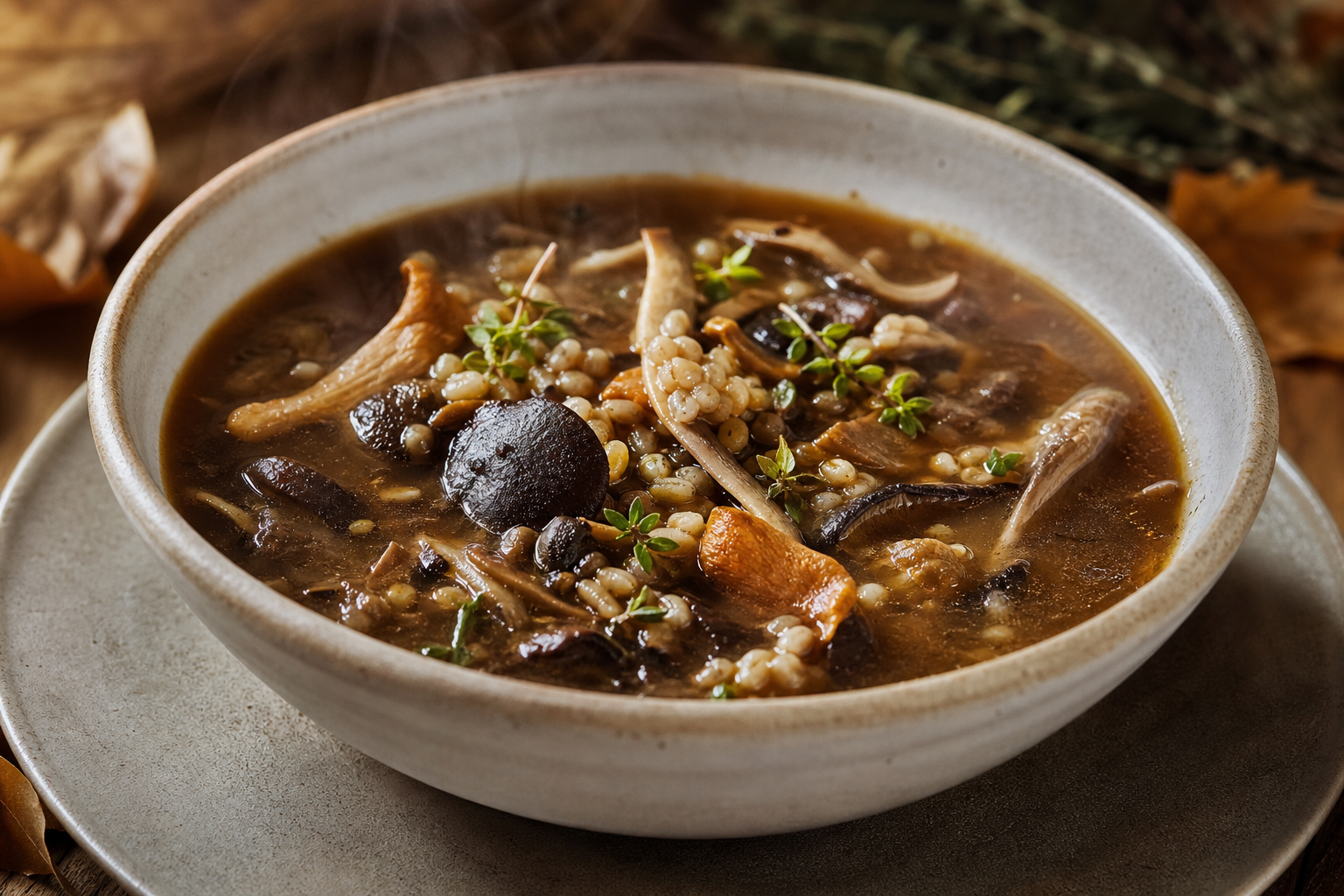
Minnesota's north woods are one of the better mushroom foraging environments in North America, and the autumn flush from late July through the first hard frost in October produces a sequence of species that any serious cook with access to a knowledgeable forager should be paying attention to. Chanterelles — Cantharellus cibarius and several related species — appear in late July and into August, growing in association with hardwood roots, most often in mossy ground under oak, maple, and birch. They are golden, trumpet-shaped, with a faint apricot smell that is the first reliable identifier. Hen-of-the-woods, also called maitake, comes later in the season and grows in dense clusters at the base of old oak trees, often the same oak year after year. A single fruiting body can weigh ten pounds or more. Oyster mushrooms appear on dead elms and other hardwood snags throughout the season, particularly in damp years.
Foraged mushrooms are not interchangeable with the commercially cultivated mushrooms available at supermarkets, even when the species are nominally the same. The flavor is more concentrated, the texture is firmer, and the cooking behavior is different. A wild chanterelle has perhaps three times the flavor intensity of a cultivated white button mushroom of the same weight, which means a smaller quantity does more work in the finished soup. If you are not comfortable foraging — and unless you have been trained, you should not be foraging on your own — Minnesota now has several reliable wild mushroom vendors who sell at the Twin Cities farmers markets and through restaurant supply networks. Forage Trail and similar small operations work directly with verified foragers and bring the product to market in good condition.
Barley as a Minnesota Crop
Barley does not get the same agricultural attention in Minnesota that corn and soybeans do, but the state is a significant barley producer, particularly in the western counties where the cooler summers and shorter growing season favor small grains over the major row crops. Most of the Minnesota barley harvest goes to the brewing industry — the state is home to substantial malting operations that supply breweries across the country — but a meaningful percentage also goes to food use, including pearl barley for soups and stews. The grain has been a staple in northern climates for thousands of years; it is one of the oldest domesticated cereals and one of the most cold-tolerant.
Pearl barley is barley that has had its outer hull and most of its bran removed through abrasion. It cooks in thirty to forty-five minutes, which is much faster than the unhulled or lightly pearled versions that some cooks prefer for their fuller flavor. For a soup, pearl barley is the right choice. It cooks down within the simmering time of the other ingredients without requiring a separate process, and it produces the slightly creamy, rounded texture that comes from the released starch interacting with the broth. The grains stay distinct rather than dissolving, which is what gives the soup its structural character.
Textural Counterpart, Not Filler
The distinction between barley as a textural counterpart and barley as a filler is the difference between a soup that has been thought about and a soup that has not. Filler is what happens when you use too much grain to extend a thin broth into something that approximates substance. The grain dominates. The mushrooms get lost. The finished soup tastes mostly of barley and feels like cafeteria food. A textural counterpart is what happens when the grain is in proportion — meaningful but secondary — and contributes a chewy resistance against the soft, slightly slippery texture of cooked mushrooms. The ratio matters. For six cups of broth and a pound of mushrooms, three-quarters of a cup of pearl barley is the right quantity. More and the barley takes over. Less and it disappears.
The mushrooms need to be browned before the broth goes in. This is the step that most non-mushroom-experienced cooks skip, and skipping it produces a flat, beige, watery soup that no amount of seasoning will rescue. Mushrooms release a substantial amount of water when they hit a hot pan, and that water needs to evaporate before the Maillard browning can begin. Cook the sliced mushrooms in butter, in a wide pan rather than a deep pot, until the liquid has cooked off and the mushroom surfaces are deeply browned. Only then do they have the concentrated flavor that will hold up against the long simmer with the barley.
The Broth Decision
The base broth is the foundation of the finished soup, and the choice matters. A mushroom broth — made from dried porcini or from the trimmings of the wild mushrooms you are using — gives the soup the deepest, most integrated mushroom flavor. A vegetable broth is the next best option; use one that is not too sweet or tomato-forward. Chicken stock will work but tends to push the soup toward a chicken-mushroom rather than a mushroom-with-grain character. Beef stock is too dominant for the delicate wild mushrooms and should be avoided. If you have time, save the stems and any trimmings from the mushrooms during prep, simmer them with an onion and a few peppercorns for forty-five minutes, and use the resulting broth.
The cream at the end is optional but argued for. A quarter cup of heavy cream stirred in at the end of cooking rounds the broth and softens the textural contrasts. It is not necessary; some cooks prefer the cleaner, more austere version without dairy. Both are defensible. Finish with fresh thyme leaves and a generous grind of black pepper. Serve with bread that can handle the broth — a crusty country loaf, a rye, anything with structural integrity. This is a soup for October, when the mushroom season is at its peak and the evenings have started to want something substantial.
Independent criticism takes time
No advertising, no sponsored content. Reader support keeps this publication going — and keeps us beholden to no one but you.