Two Harbors is a working harbor town twenty-six miles up the North Shore from Duluth, and the fish-house tradition along this stretch of Highway 61 is one of the few remaining American food categories that has refused to be modernized into something it is not. The fish house is a counter-service operation, usually with a smokehouse attached, that buys fish from the small remaining Lake Superior commercial fishing fleet and prepares it the way it has been prepared on this lake for a century. The form does not have a cocktail program because no one is asking for one. It does not have a tasting menu because the tasting menu is not what people drive to a fish house for. North Shore Fish House, which has been operating in its current building since the 1970s and in the same family for the last two decades, is one of the better examples of the form in operation, and the question of whether it can be rated within the framework of a publication that primarily covers fuller-service restaurants is the question this review is honestly trying to answer.
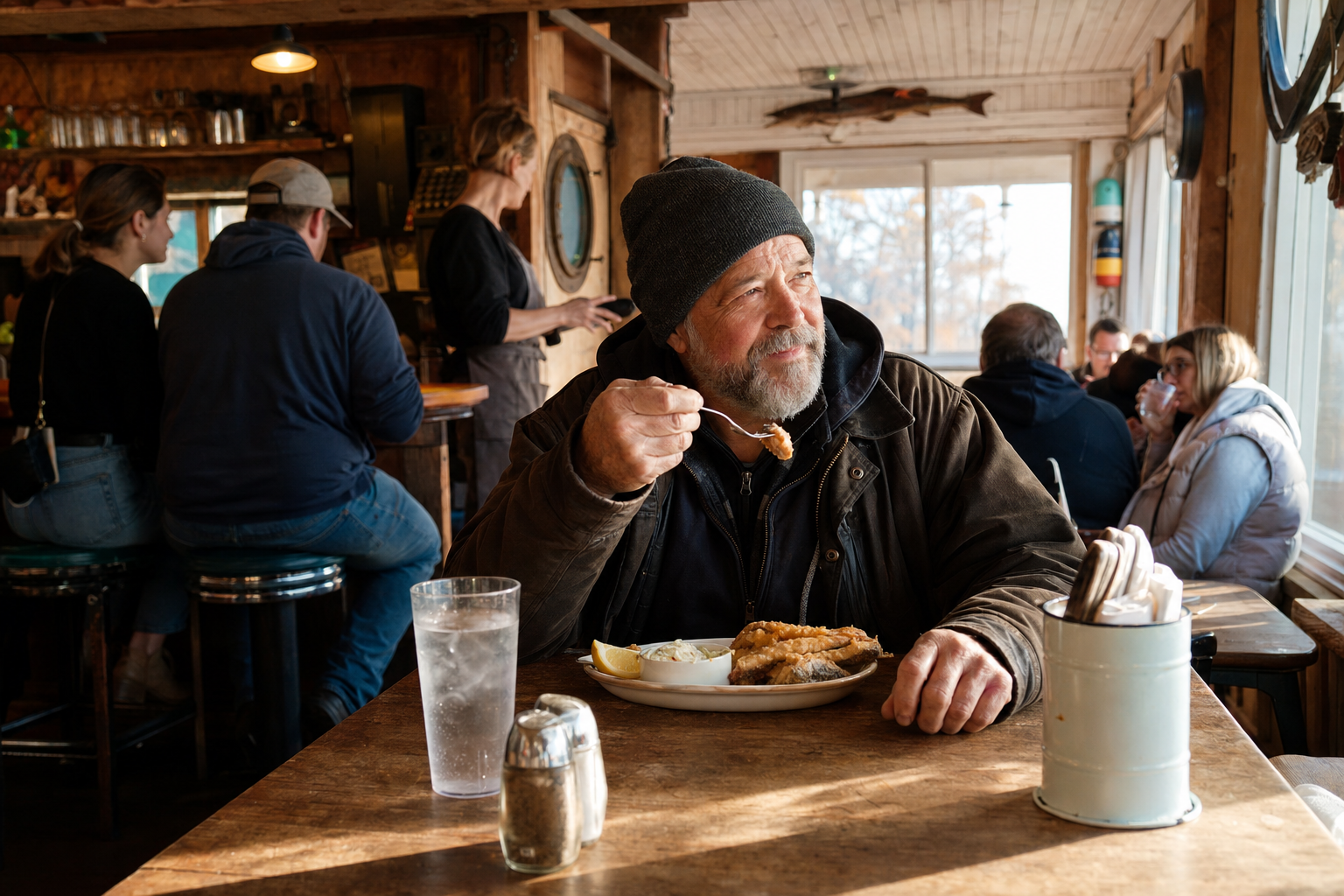
The building sits on the highway side of Two Harbors with a gravel parking lot that fills up by eleven on a summer weekend and empties out around dinner time when the day-trippers head back to Duluth. The dining room has six tables, all bolted to the floor, with vinyl tablecloths that the staff wipes down between sittings. The smell of woodsmoke and lake water is the most prominent sensory fact in the room and is impossible to reproduce in any other environment. The counter is at the back of the room with a chalk board above it listing the day's preparations and what the kitchen has run out of. The chalk board is updated through the day as inventory shifts. On the visit, by two in the afternoon, the smoked whitefish had a line through it. The smoked lake trout was holding.
The Fish and the Smoke
The smoked lake trout is the most important item on the menu and the strongest argument for the drive. The trout comes from a commercial fishing operation based out of Knife River, a few miles south of Two Harbors, and is delivered fresh in the morning and into the smokehouse by mid-morning. The smoke is alder, applied at a low temperature for several hours, and the fish emerges with a properly developed crust on the outside and an interior that has retained its moisture without becoming flaky. The trout is served whole, wrapped in butcher paper, with a portion of crackers and a small ramekin of horseradish cream on the side. There is no plate. There is no garnish. The wrapping is the plating. The fish is the meal. This is the correct presentation for the dish and the kitchen has never seen any reason to change it.
The smoked whitefish, when it is available, is the second-best item in the smokehouse. The whitefish carries the smoke differently than the trout — the flesh is denser and the fat distribution is more even, which means the smoke penetrates more evenly and the resulting fish has a more uniform character throughout the cut. The whitefish is also served whole, also wrapped in butcher paper, and is best eaten with the same crackers and the same horseradish cream. The fish-house tradition has not seen any reason to vary the supporting cast and this is correct.
The beer-battered walleye platter is the menu's largest plate and the one that most clearly fulfills the platonic ideal of the fish house. The walleye comes from the same commercial fishing operations as the trout, is cut into portions in the morning, and is battered to order in a beer-and-flour batter that the kitchen has been making the same way for decades. The fish is fried in a tallow blend at the correct temperature and arrives at the counter hot enough to require a moment of cooling before eating. The platter includes hand-cut fries, a portion of coleslaw made in-house with apple-cider vinegar, and a small portion of tartar sauce. The platter is sized to feed two people who are seriously hungry, or three people who are eating it as part of a larger road-trip meal pattern. The price is twenty-two dollars. There is no version of this plate in Minneapolis that costs less than thirty-five and produces the same quality of fish.
What the Form Does Not Have
There is no cocktail program. There is no wine list. The beverage selection consists of a few local craft beers in cans, a domestic mass-market lager on draft, soft drinks, and coffee. This is not a limitation that the kitchen is apologizing for or planning to address. It is the structural fact of the form. A fish house is a place to eat fish; the drinks are an afterthought because the fish is the entire argument. The cocktail score in the Four Loons rubric is unavoidably low for a venue of this type, and the rubric's loon-gating logic correctly identifies that the absence of a beverage program prevents the venue from clearing the threshold required for a loon designation. The rubric is doing what the rubric should do.
The service is counter service, with the order taken at the counter, the food prepared and called out when ready, and the table-clearing handled by the same staff that takes orders during slower periods. The staff is friendly without being polished, knowledgeable about the day's fish without being rehearsed, and willing to direct a first-time visitor to the items that are at their best on a given day. The service score reflects the form rather than the staff's capability — counter service does not score the way full-service does, and the rubric is honest about that.
The Specific Value Proposition
The North Shore Fish House sits in the category of restaurants where the rating logic of the publication has to be honest about what it is rating. The Four Loons rubric is designed to identify restaurants that meet a minimum standard of competence across the full restaurant experience, including the beverage program and the service register. A fish house is not in this category by structural definition, and the rubric correctly identifies that. The rating is sub-loon, and the recommendation in the publication's language is recommended-with-context: this is a restaurant worth visiting for the specific experience it offers, with the understanding that what it offers is not a multi-dimensional restaurant experience but a single-dimensional argument about Lake Superior fish, smoked or fried, eaten without ceremony, at a price that reflects the proximity to the source.
The atmosphere score is the highest single dimension in the rating, and this is honest. The atmosphere of the North Shore Fish House — the woodsmoke smell, the gravel parking lot, the highway noise filtered through the building walls, the sense of being inside a working harbor town rather than a tourist version of one — is the experience that justifies the drive from Minneapolis or the detour from a North Shore vacation. The Minnesota Character score is the maximum possible, and this is also honest. There is no version of this restaurant in any other state. The form is specific to this lake, this fishing tradition, and this stretch of highway. The smoked trout is the document of that specificity, and the document is worth the drive. Fictional for illustration.