The American craft brewing industry has spent two decades chasing the hazy IPA and the pastry stout and the wild-fermented sour ale, and in the process has largely abandoned the lager tradition that built the modern beer category. Lager is a difficult beer to brew at small scale. It requires a long cold conditioning period — four weeks at minimum, six is better, eight produces the best results — and that conditioning ties up tank space that small breweries cannot easily afford to commit. Most American craft breweries respond to this constraint by either skipping lagers entirely or by brewing fast lagers that miss the point of the style. Pilsen Brewing, which opened last year in the basement of a former Polish social hall on a Marshall Street block in Northeast Minneapolis, has gone the other direction. The brewery has organized its entire production schedule around its lager program, with the resulting tap list reading as an argument about what American craft beer abandoned and what it now has the opportunity to recover.
The Northeast Minneapolis neighborhood is the right place for this argument. The area was settled in successive waves by Polish, Slovak, and Czech immigrants between roughly 1880 and 1920, and the lager-brewing tradition arrived with them. The neighborhood had at one point several small breweries serving the immigrant population, and the buildings that housed them are still scattered through the area — converted to apartments, to event spaces, to other restaurants. Pilsen Brewing is not the descendant of any of those breweries. It is, more interestingly, a deliberate reconstruction of what they were doing, made possible by the survival of the buildings, the continuity of the neighborhood's identity, and the willingness of a new generation of brewers to do the patient work that the style requires.
The Lagers as the Argument
The flagship pale lager — labeled simply Pilsen on the tap board, with no further name — is the brewery's structural argument. It is brewed to a Czech-style pilsner specification, with a malt bill that includes a meaningful proportion of floor-malted barley and a hopping schedule that uses Saaz hops from a Czech supplier rather than the more common American substitutes. The beer is cold-conditioned for six weeks before tapping. The result in the glass is dry, clean, with a faintly bready malt character and a hop bitterness that lingers on the back of the palate without becoming aggressive. The carbonation is at the right level for the style — slightly higher than American mass-market lagers, slightly lower than over-carbonated craft pilsners — and the head retention is correct. This is the kind of beer that takes a beer drinker about three sips to appreciate and then becomes the only beer the drinker wants for the rest of the visit. We ordered three.
The dark lager — a Bohemian-style tmavé pivo — is the brewery's second-strongest item. The beer is darker than a Munich dunkel and lighter than a schwarzbier, with a roasted-malt character that carries chocolate and coffee notes without becoming sweet. The cold conditioning is even longer on this beer than on the pale, which is appropriate for the style, and the resulting clarity in the glass is the kind that distinguishes a well-lagered dark beer from a hastily produced one. This is the beer to order on a December evening. The bartender will tell you so without prompting.
The seasonal program includes a Märzen in autumn, a Helles in summer, and a Doppelbock that the brewery releases in late winter and that sells out within a week of release. The Märzen on the visit was the strongest of the seasonal items: a properly bready malt character, a Vienna malt note that gave the beer a slightly nutty edge, and a finish that was dry without being thin. The beer is what an Oktoberfest beer is supposed to be when the brewer has the patience to do it correctly. The American market for this beer is small precisely because most American versions of it are not done correctly. Pilsen Brewing has the demand because the work justifies it.
The Room and the Food
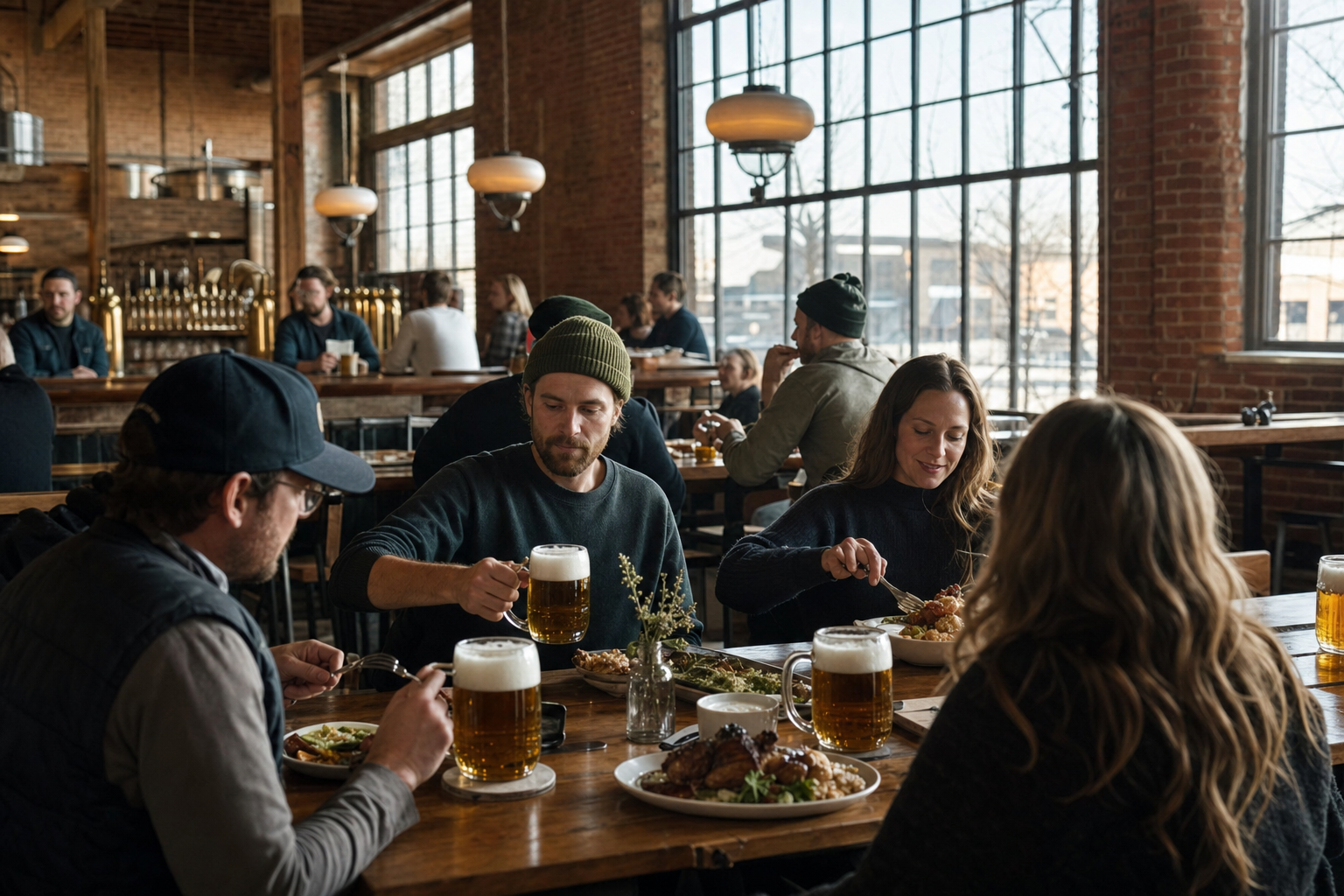
The taproom occupies the former social hall's main room, with the brewery itself visible through windows along the back wall. The room is large enough to seat about eighty at full capacity, with a mix of bar seating, communal long tables, and a few smaller tables along the perimeter. The lighting is dim without being dark. The sound level is conversational at most hours and louder on Friday and Saturday evenings when the room fills up. The bar staff is knowledgeable about the beers and willing to talk about the brewing schedule in some detail, which is the right service register for a brewery taproom of this size.
The food program is intentionally modest. The kitchen consists of a small service galley capable of producing a short menu of pretzels, sausages, sandwiches, and pickled vegetables. The pretzels are made on-site daily and are correctly textured — a soft interior with a properly lye-bathed exterior — and served with a house-made mustard. The sausages are sourced from a Northeast Minneapolis butcher that has been operating in the neighborhood for several decades, and the brewery serves them with sauerkraut that the brewery ferments itself. The food is appropriate for the beer. It is not the reason to come. The brewery does not pretend otherwise, and the food score reflects that the food is functional rather than ambitious.
The pricing is honest. A flight of four small pours runs ten dollars. Pints are seven for the flagship and eight for the seasonals. A pretzel-and-sausage plate that will feed two as a substantial snack is sixteen. This is the pricing of a brewery that is making its money from beer rather than from food and that has set its expectations accordingly. The value proposition for a guest who is there for the beer is among the best in Northeast Minneapolis.
What the Czech Reference Means
Pilsen Brewing's central argument — that the lager tradition is worth the patient work it requires and that American craft brewing's flight from lagers has been a mistake — is being made through the beers themselves rather than through marketing language. The brewery does not have an extensive backstory on its labels or a manifesto on its menu. It has a tap list that includes four lagers at any given time, each conditioned for the appropriate period, each made with the appropriate ingredients, each served at the correct temperature and carbonation level. This is what a brewery looks like when it has chosen its argument and committed to it without needing to explain itself.
The food rating prevents the brewery from clearing the food gate that the Four Loons rubric requires for a loon designation, and that is the correct outcome of the rubric. A guest visiting Pilsen Brewing for the food will be disappointed; a guest visiting for the beer will be among the most satisfied beer drinkers in the metro. The recommendation, in the language the publication uses for sub-loon rooms, is strongly recommended for the beer program. The neighborhood's Czech inheritance is being honored not through nostalgia but through the actual brewing work that the Czech tradition requires. That is the more meaningful tribute. Fictional for illustration.